Camera and collimator systems¶
The systems/ directory ships ready-made camera presets. Each is an IncludeFile fragment that
defines a collimator and a detector crystal with validated, literature-sourced geometry. Including one
gives you a clinical camera in a single line; you then add the parts specific to your study.
Using a preset¶
Include a single preset per deck, then supply the world, physics, source, scorer, and the detector extents and placement the preset leaves open:
IncludeFile = systems/symbia_lehr.txt      # defines Ge/Collim and Ge/Crystal

# you provide the size of the head and where it sits:
i:Ge/Collim/NHolesX = 120
i:Ge/Collim/NHolesY = 120
d:Ge/Collim/TransZ  = 12.025 mm            # front collimator face at z = 0
d:Ge/Crystal/HLX    = 90. mm
d:Ge/Crystal/HLY    = 90. mm
d:Ge/Crystal/TransZ = 29.05 mm             # small gap behind the collimator
The preset fixes the physics-bearing geometry (hole diameter, septal thickness, hole length, crystal
material and thickness); you fix the size of the detector head (number of holes, crystal extent) and
where it sits. Each preset's header comment gives the recommended placement and the photopeak
window to apply in post-processing. See systems/README.md for the full contract.
Available presets¶
Siemens Symbia (NaI):
| Preset | Collimator | Typical use |
|---|---|---|
symbia_lehr.txt |
Low-Energy High-Resolution | 99mTc, 177Lu (208 keV with care) |
symbia_lphr.txt |
Low-Penetration High-Resolution | low-energy, penetration-sensitive |
symbia_me.txt |
Medium-Energy | 111In, 177Lu |
symbia_he.txt, symbia_hegp.txt |
High-Energy | 131I (364 keV) |
GE Anger cameras (NaI):
| Preset | Collimator |
|---|---|
ge_lehr.txt |
Low-Energy High-Resolution |
ge_legp.txt |
Low-Energy General-Purpose |
ge_elegp.txt |
Extended Low-Energy General-Purpose |
ge_megp.txt |
Medium-Energy General-Purpose |
ge_hegp.txt |
High-Energy General-Purpose |
ge_uhehr.txt |
Ultra-High-Energy High-Resolution |
CZT systems:
| Preset | System |
|---|---|
ge870czt_wehr.txt |
GE Discovery NM/CT 870 CZT, WEHR-analogue |
starguide.txt |
GE StarGuide (12-column CZT ring) |
dspect.txt |
Spectrum Dynamics D-SPECT (tungsten square holes) |
Detector-only building blocks:
detector_nai.txt and detector_czt.txt define just the crystal material and thickness, for pairing
with a custom collimator you build yourself (see Designing detectors and collimators).
How proprietary geometry is graded
Vendor collimator dimensions are largely proprietary. Every preset's header states its source and a reliability grade: manufacturer datasheet, multi-source-corroborated, single peer-reviewed, or third-party Monte Carlo reconstruction. Where a system's geometry is genuinely unpublished (for example, StarGuide's collimator), the preset says so. Treat the low-graded presets as reasonable working models that approximate the real hardware, and see Validation §4 for how the sensitivities compare against independent measurements and simulations.
Choosing a collimator¶
The collimator is the fundamental resolution–sensitivity trade-off in SPECT, and the right choice depends on your isotope's photon energy:
- Low-energy collimators (LEHR, LEGP), for ~100–160 keV emitters (99mTc, and the 113/208 keV lines of 177Lu with attention to penetration). Thin septa give the best resolution but leak at higher energies.
- Medium-energy (MEGP, ME), for ~200–300 keV (111In, 177Lu 208 keV).
- High-energy (HEGP, HE), for ~364 keV and above (131I). Thick septa suppress penetration at the cost of sensitivity and resolution.
If you image a high-energy isotope through a low-energy collimator, expect a large septal-penetration tail, which OpenTOPAS-SPECT shows explicitly because it models the collimator approximated.
Full-system examples¶
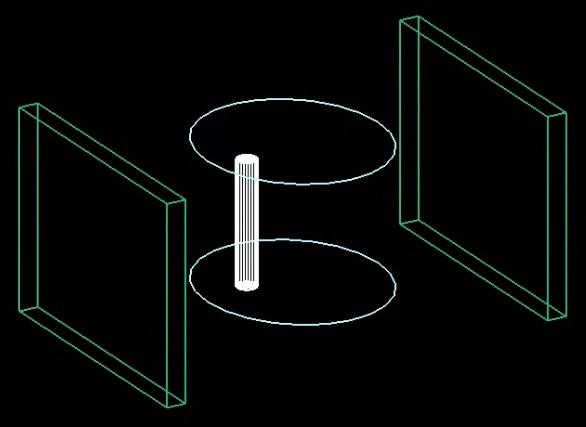
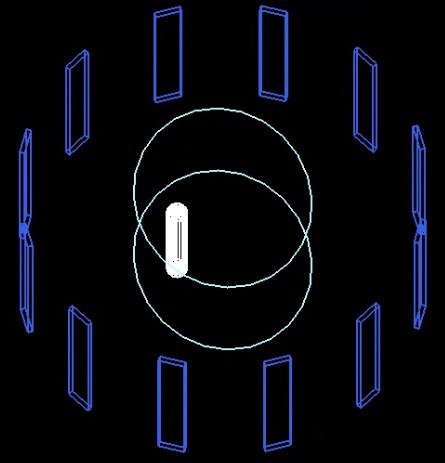
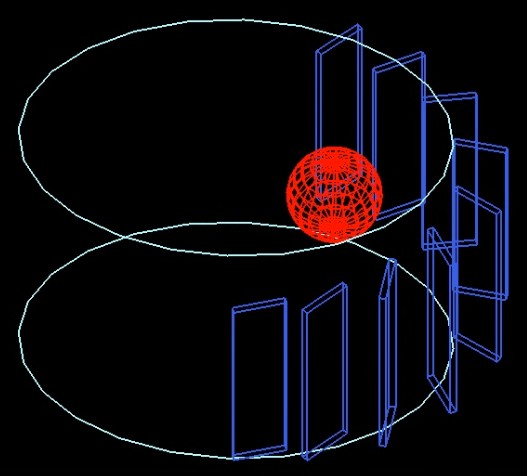
Left to right: the dual-head Anger camera, the StarGuide 12-column CZT ring, and the D-SPECT swiveling-panel array (OpenTOPAS Qt viewer snapshots of the shipped decks).
The presets above define a single detector head. To mount an entire camera with its motion, ready
to combine with a phantom, see
examples/acquisition/:
dualhead_orbit.txt— a dual-head Anger camera (two heads 180° apart) orbiting a body phantom on a gantry time feature. This same arrangement models any NaI Anger camera (Siemens Symbia, GE Discovery/Infinia); the collimator/crystal geometry for a given camera comes from thesystems/presets.starguide_ring.txt— the GE StarGuide 12-column CZT ring with its adaptive dock-and-rotate motion, generated bymake_ring_motion.py.dspect_scan.txt— the Spectrum Dynamics D-SPECT cardiac system: 9 CZT columns in a fixed fan over the chest, each swiveling in place to sweep a heart region of interest (the columns do not orbit).
These are geometry-and-motion examples: open any of them in the OpenTOPAS Qt viewer to watch the full
system move around the patient, then add your phantom's activity sources and a scorer for a complete
acquisition. The three arrangements plus the systems/ presets cover the shipped cameras: dual-head
Anger (all the NaI cameras, by collimator swap), the StarGuide CZT ring, and the D-SPECT swiveling
CZT panels.