QA phantoms
The phantoms/qa/ library encodes the standard nuclear-medicine quality-assurance phantoms, so you can
assess an OpenTOPAS-SPECT system the way you would a real gamma camera: tomographic uniformity,
spatial resolution, and contrast recovery. Every dimension comes from a manufacturer datasheet
or an international standard, not an assumption (provenance in
research/knowledge/spect-qa-phantom-geometry/).
What ships
| Phantom | Encodes | Test it supports |
|---|---|---|
| Jaszczak Deluxe | water cylinder + cold rods + cold spheres | uniformity, resolution, contrast, in one acquisition |
| NEMA IEC body | hot spheres in a warm body with a cold lung | contrast recovery coefficients |
| NEMA NU-1 sources | thin line/point sources at 7.5 cm spacing | system spatial resolution (FWHM) |
Running one
The phantoms are IncludeFile fragments; the shipped example decks image them end-on through a Siemens
Symbia LEHR head (Tc-99m). Run from the example's own folder:
Each deck writes a planar projection (EnergyDeposit per crystal pixel, CSV). Apply the 140.5 keV
photopeak window in post-processing, and rotate the detector for a tomographic series (see examples/phantom/spect_acquisition.txt).
The Jaszczak phantom
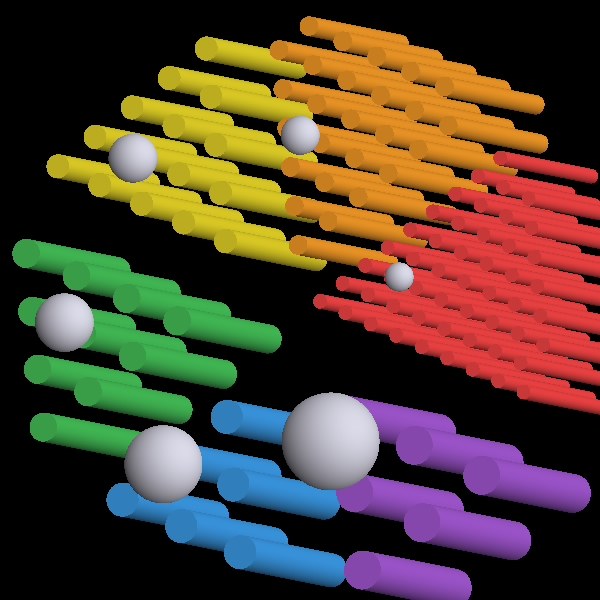 The six cold-rod sectors (finest red to coarsest purple) and six cold spheres, with the water
cylinder hidden.
The six cold-rod sectors (finest red to coarsest purple) and six cold spheres, with the water
cylinder hidden.
A single water-filled acrylic cylinder (216 mm inner diameter, 186 mm tall, 3.2 mm wall) with three inserts, so one acquisition covers three tests:
- Cold rods — six 60 deg sectors of PMMA rods, one diameter per sector (Deluxe: 4.8 to 12.7 mm), in a hex lattice with center-to-center pitch equal to twice the rod diameter (from Jaszczak's patent). The finest sector still resolved sets the tomographic spatial resolution.
- Cold spheres — six PMMA spheres (9.5 to 31.8 mm) for contrast versus size.
- Uniform section — the plain water gives integral and differential uniformity.
Because the rods and spheres are non-active PMMA sitting in a uniformly active water background, they read as cold voids. Other Jaszczak variants (Ultra Deluxe, Standard, Benchmark) differ only in the rod and sphere diameters and are one flag away:
The NEMA IEC body phantom
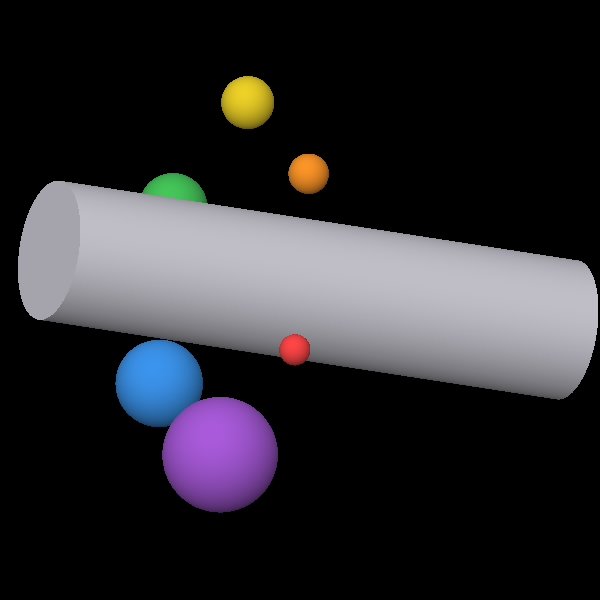 The six fillable spheres (10 to 37 mm) around the central lung insert, body wall hidden.
The IEC 61675-1 / NEMA NU 2-2018 body: an elliptical PMMA cavity (interior 290 mm lateral x 221 mm AP x 193 mm, ~9.7 L) holding six fillable spheres (inner diameters 10, 13, 17, 22, 28, 37 mm, centers 70 mm from the lid) and a cold low-density lung insert (45 mm foam, 0.3 g/cm3). The spheres are hot at a selectable sphere-to-background concentration ratio (default 4:1); measure how much of each sphere's true concentration you recover as a function of its size.
The small spheres carry few counts by design (their activity is concentration x volume, and a 10 mm sphere is a tiny fraction of a 9.7 L background) — that is exactly why they are the hard ones to recover. Scale all histories up together to gain statistics without changing the ratio.
NEMA NU-1 resolution sources
Three thin line sources (capillary bore under 1 mm) at 0 and +/-75 mm, the NEMA 7.5 cm spacing. Imaged end-on they appear as point spread functions; the fitted FWHM of each is the system spatial resolution. Add the surrounding 20 cm water cylinder for the with-scatter measurement:
Caveats
- Emission defaults to Tc-99m (140.5 keV). For another isotope, edit
So/*/VolumetricEnergyand use a collimator preset matched to its energy. - Sphere walls (~1 mm PMMA) are not modeled — a small, documented approximation.
- The IEC body cross-section is modeled as an ellipse; the exact IEC contour is a slightly non-elliptical refinement.